
AI decision audit trail · EU AI Act Articles 12 & 14
Tamper-evident records for every AI decision.
Write-once storage, monotonic sequence numbers, and client-side hashing. An audit ledger that runs inside your infrastructure and produces the evidence Article 12 and Article 14 ask for.
S3 Object Lock · per-tenant sequence numbers · MCP server on npm · Apache 2.0
What a sealed record looks like
The JSON your system writes, and the verification output an auditor can run themselves.
The recorded decision
"event_id":          "8f2a1c7e-4d3b-4b9d-9e21-7c0a1f55c2a9",
"timestamp":         "2026-06-15T09:42:11Z",
"tenant_id":        "acme-lending",
"sequence_no":       48217,
"model_version":     "claude-sonnet-4-6",
"human_in_loop":     true,
"input_data_hash":   "sha256:3b1f...c2a9",
"system_prompt_hash":"sha256:9d4e...77b0",
"ai_decision_output": {
  "decision":    "refer_to_human",
  "risk_tier":   "high",
  "reason_code": "affordability_marginal"
}
The verification, run on demand
verify_decision 8f2a1c7e...c2a9

integrity_verified:  true
sequence_complete:   true   (no gaps, 1..48217)
human_oversight:     recorded
archived:            s3 object-lock COMPLIANCE
retain_until:        2033-06-15
pii_at_rest:         none   (client-side hashed)
Integrity proves nothing was altered. Sequence completeness proves nothing was deleted. Together they answer the only two questions an auditor really has.
How it wires in
The ledger runs inside your own infrastructure, cloud or on-premises. Your data never leaves your environment, and personal data never reaches the ledger.
-
Integrate
One Model Context Protocol config block, or a few lines of the Python or Node SDK. Your agents write a decision record at the moment each decision is made. Personal data is hashed client-side before anything leaves your process.
-
Record and seal
Each decision is hashed, given a monotonic sequence number, and written to write-once storage (AWS S3 Object Lock in COMPLIANCE mode in the cloud, equivalent controls on-premises). It cannot be edited or deleted before its retention date.
-
Prove on demand
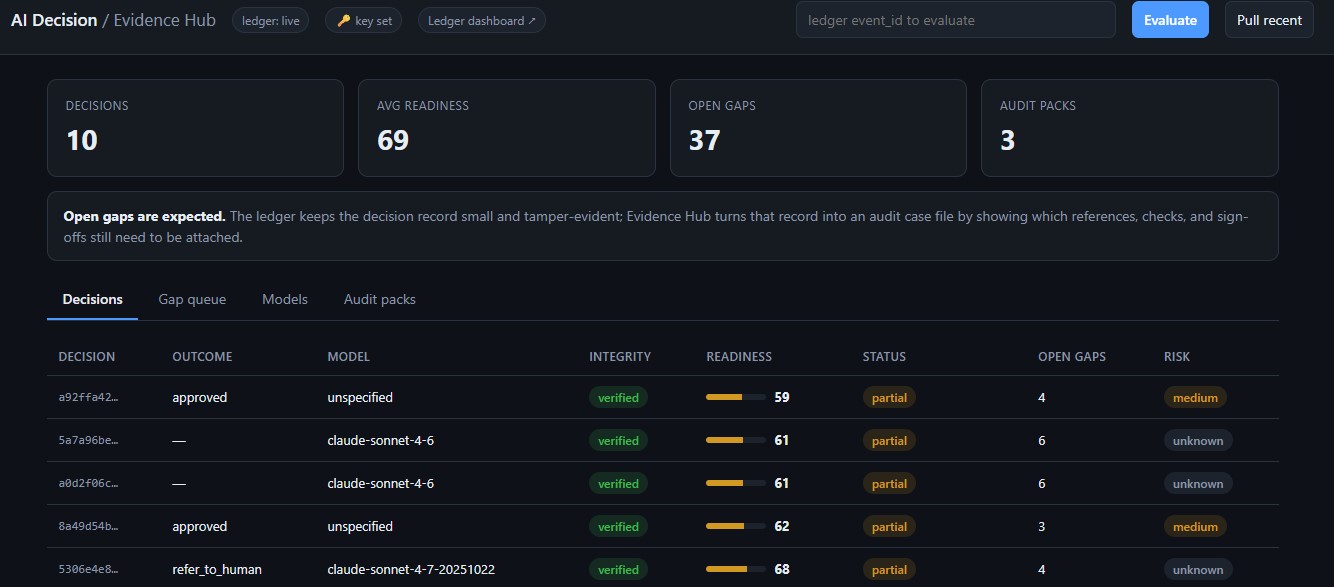
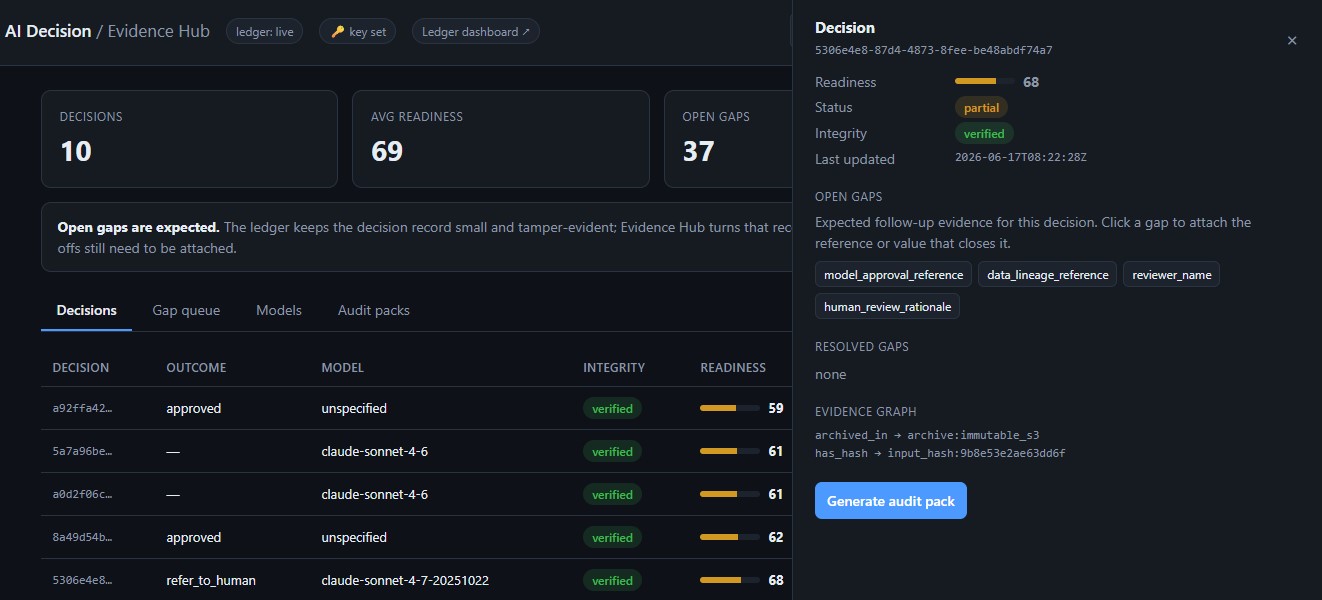
When a regulator or auditor asks, produce the full trail: every decision, a proof nothing was altered, a proof nothing was deleted, and the human-oversight record. The Evidence Hub scores each decision and exports an audit pack.
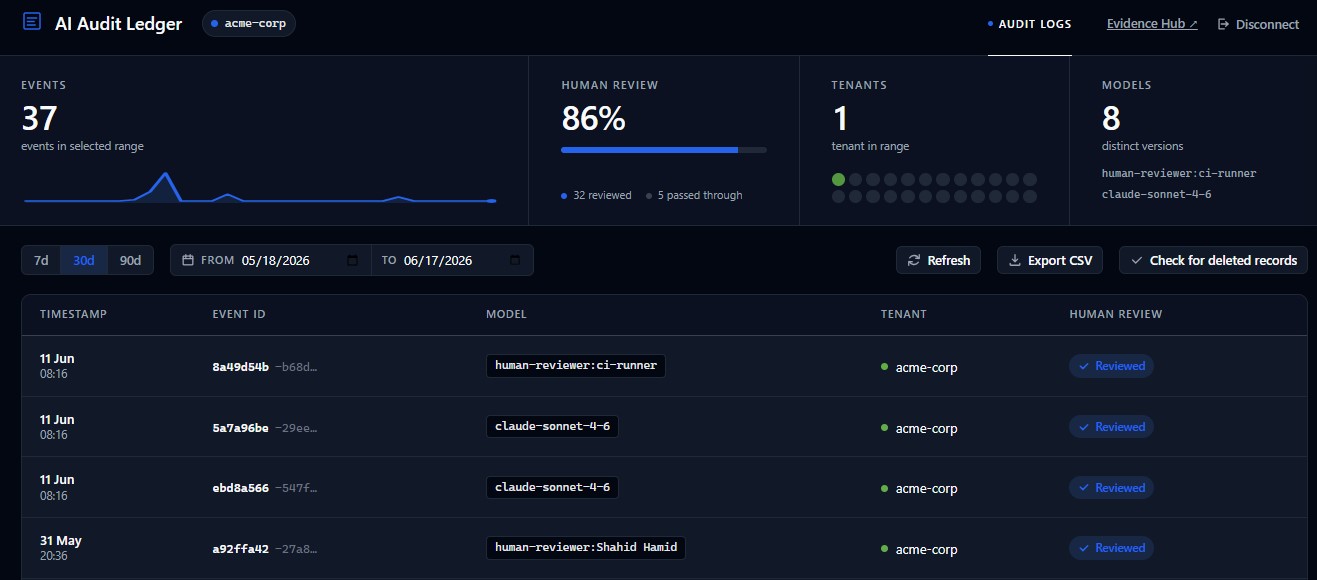
Two dashboards inside your boundary
The tamper-evident ledger of every event, and the Evidence Hub that scores each decision and tracks the gaps to close.
2 August 2026: high-risk record-keeping starts
EU AI Act high-risk obligations land on 2 August 2026. Article 12 requires automatic, tamper-resistant record-keeping for the lifetime of every high-risk AI system. Article 14 requires evidence of human oversight. Most fintechs running AI in credit, fraud, or onboarding are not ready, and record-keeping is the one control you cannot retrofit after the fact. The records have to exist from the first decision, or they do not exist at all.
Controls a CISO and a regulator both ask about
- Immutable storage
- AWS S3 Object Lock in COMPLIANCE mode. Records cannot be deleted before their retention date, by anyone, including the account owner.
- 7-year retention
- Configurable to your regulator. Covers EU AI Act Article 12 and FCA SS1/23 model-risk expectations.
- No PII at rest
- Personal data is HMAC-SHA256 hashed client-side, keyed to a secret only you hold. The ledger stores fingerprints, never raw data.
- Completeness proofs
- Per-tenant monotonic sequence numbers and a verify-completeness check prove no record was silently dropped or removed.
- Human-oversight tracking
- Human-in-the-loop steps are recorded against the decision, the evidence Article 14 asks for.
- Your boundary
- Your cloud account or your own data centre. Your keys, your network, your logs. Zyvra never holds your data.
Pricing
No per-seat licensing, no per-decision metering. Self-host for free, or we deploy and hand over the stack inside your infrastructure.
Free · Apache 2.0
Self-host the whole stack
- Ledger, MCP server, Evidence Hub, dashboards
- Public sandbox, no account required
- Python and Node SDKs, CDK deploy scripts
- Community support via GitHub
Done for you
Contact us for pricing
- Deployed into your infrastructure for your team to run
- Or managed by us inside your environment
- Full handover of code, IaC, and runbooks
- Compliance-ready configuration and audit-pack walkthrough
Source repositories
Open source under Apache 2.0. The MCP server is on npm and listed in Anthropic's MCP Registry.
-
audit-ledger
DynamoDB for live query, S3 Object Lock for the immutable copy, Python and Node SDKs, compliance dashboard. CDK stack for your own account.
github.com/shahidh68/audit-ledger → -
audit-ledger-mcp
Model Context Protocol server: record_decision, verify_decision, verify_completeness, list_decisions. One config block for Claude Desktop, Cursor, or LangGraph.
npm package → · GitHub → -
evidence-hub
Scores each recorded decision 0–100, flags missing evidence and owners, exports audit packs.
github.com/shahidh68/evidence-hub → -
langgraph-loan-triage
Reference workflow: triage, risk, human-in-the-loop, every step recorded to the ledger.
github.com/shahidh68/langgraph-loan-triage →
Common questions
Is it tamper-proof?
It is tamper-evident, which is the standard regulators and auditors actually use. Deletion is prevented by S3 Object Lock in COMPLIANCE mode; any alteration is provable through hash verification; and completeness checks prove nothing was dropped. "Tamper-proof" overclaims; tamper-evident is what holds up in a review, and what the ledger delivers.
Where does it run, and who holds the data?
Inside your own infrastructure, cloud or on-premises. Your keys, your network, your logs, your account. Zyvra never holds your production data. Personal data is hashed client-side, so no PII ever reaches the ledger in the first place.
How is this different from normal application logging?
Application logs can be edited, rotated, or deleted, and they cannot prove a record was never there. Zyvra writes to immutable storage, assigns per-tenant sequence numbers so a missing record is detectable, and verifies integrity on demand. It answers "prove nothing was changed or deleted," which logging cannot.
Which EU AI Act obligations does it cover?
Article 12 (automatic, tamper-resistant record-keeping over the system's lifetime) and the evidence side of Article 14 (human oversight). It produces the records and proofs; your organisation owns the attestation and the legal interpretation. Our free checklist walks through the wider obligations.
What does it cost?
The repositories are open source under Apache 2.0, free to self-host. As a product it's deployed into your own infrastructure for your team to run, managed by us inside your environment, or handed over as code. Contact us for pricing.
Does it support on-premises, not just AWS?
Yes. AWS S3 Object Lock is the cloud reference implementation; on-premises uses equivalent write-once storage and your own IT controls. The ledger, the MCP server, and the Evidence Hub all run inside whichever boundary you choose.
Contact
Tell us what your AI system decides, which regulator you answer to, and where the audit trail is today. Reply within two business days from the engineer who builds it.
Or use the form below.
Prefer email? hello@zyvra.studio